Published Aug 5, 2026
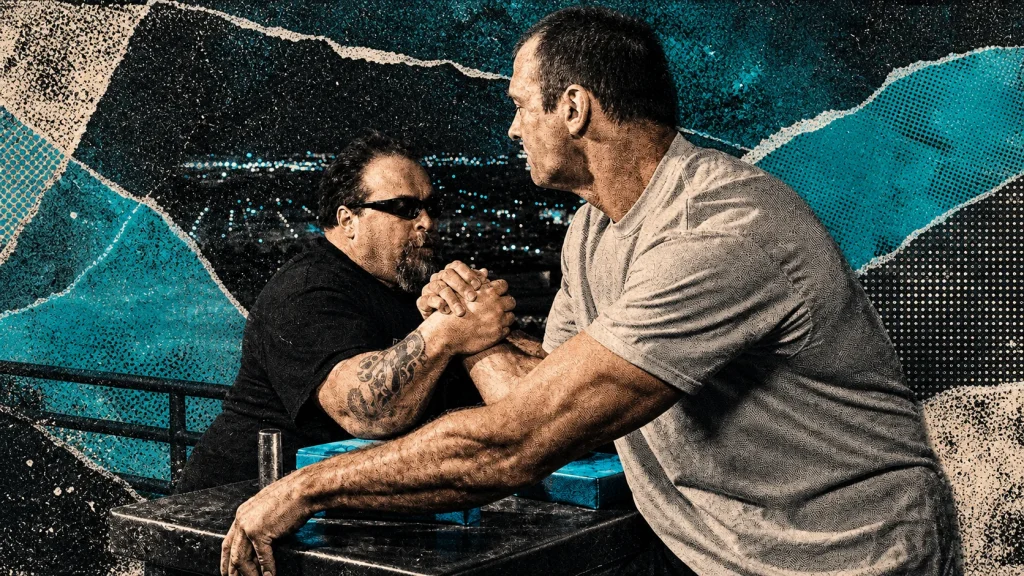
The version of Devon Larratt most fans picture begins outside. He rises, protects pronation, gives away center, and extends the hand fight through the strap.
Early Devon started from a different lane. His first reliable option was the hook, where cup, shoulder commitment, and side pressure worked as one connected system.
That important because his later defensive style grew from an inside puller’s understanding of pressure. The outside game added range to a foundation already built at close quarters.
The Shoulder Was Part of the Hand
Early Devon did more than curl an opponent’s wrist. He tried to secure enough cup to bring his shoulder behind the hand, close the angle, and drive sideways without separating his arm from his body.
The wrist gave him access. The shoulder made the position dangerous.
Against strong inside pullers, he could stay connected through long exchanges and keep testing the same line. His endurance mattered, but it served a technical purpose. Every surge asked whether the opponent could preserve cup and arm angle while Devon kept his own shoulder engaged.
The approach also explains why his outside attempts could look secondary. When a toproll stalled, he often had a familiar route back into the match. He could regain cup, bring the shoulder forward, and convert hand control into side pressure.
His Toproll Was a Change of Lane
Calling early Devon an inside puller still leaves room for variation. He could climb, rise, and attack the fingers. He could reverse outside when an opponent overcommitted to the hook. The key difference was priority.
The toproll helped him reach the position he trusted. It was often a setup, escape, or adjustment rather than the permanent defensive home associated with his mature career.
That lane switching appeared against elite opposition. Devon could test height, lose the hand fight, then reconnect through the cup and shoulder. He was already solving positions instead of repeating one move.
His later reputation for table problem-solving was visible early, even while the answers came from inside. That competitive adaptability also fits the discipline behind Devon’s military-shaped table persona, where discomfort becomes information instead of panic.
The Later Devon Reversed the Order
Years later, the outside structure became the base. Pronation, back pressure, strap control, and an open arm angle let Devon survive where his younger version would have tried to close the match.
The sequence changed. Early Devon used outside movement to recover the hook. Mature Devon used inside pressure as a threat that protected his outside lane.
That is why discussions about Devon’s aging problem miss something when they treat adaptation as simple decline. His style changed because he kept reorganizing which tools carried the greatest load.
The hook came first. It taught Devon how wrists fail, how shoulders connect, and how pressure accumulates. The king’s move era made him look like a different puller, but the inside education remained underneath it.

I was born in the 1980s, so like a lot of fans, Over the Top was my first introduction to pro arm wrestling. Years later, Devon Larratt’s YouTube channel pulled me back in, and I’ve been hooked ever since. Rewatching classic matches, following the modern supermatch hype, and keeping up with the personalities, rivalries, and culture that make arm wrestling so addictive.