Published August 8, 2026
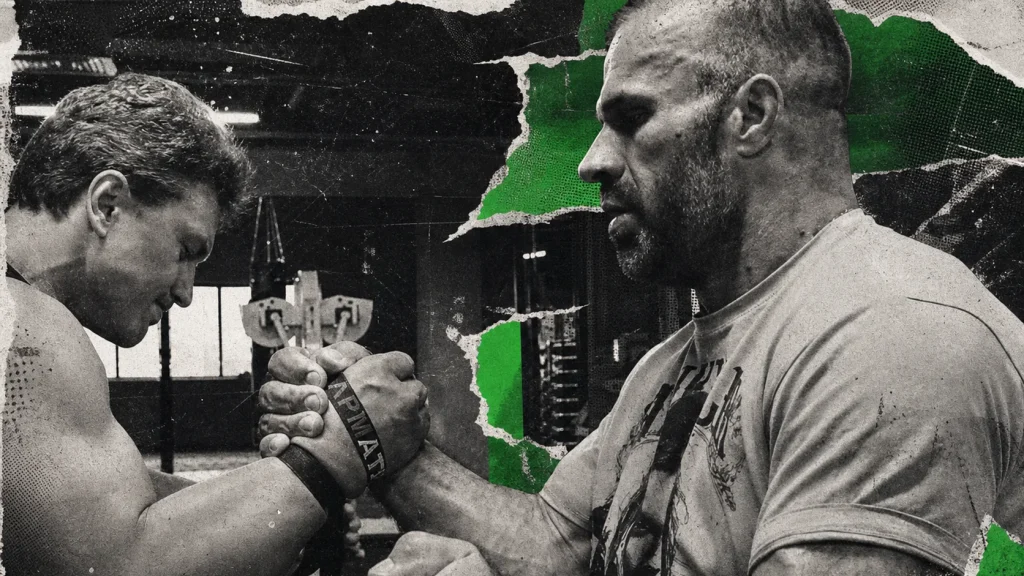
The first pin is the loudest moment in the new Denis Cyplenkov practice footage. It is also the least useful one. Artur Makarov drives through Denis before the larger man has settled into the pull.
Then Denis adds pressure. Slowly, almost politely. Makarov reaches the same lane and suddenly finds a wall where an open path had been seconds earlier.
That change matters more than the score anyone wants to keep in a gym. Denis still understands how to turn a loose start into a position he can own. The strength arrives through control rather than a violent hit.
The Stop Begins in the Hand
Makarov is a serious lightweight with a thick forearm and enough inside power to make the exchange meaningful. He also gets the better of Denis early. Practice footage deserves that honesty.
The useful sequence comes later. Makarov tries to curl around Denis’s pronation and bring the match inside. Denis keeps his knuckles facing through the grip, holds the wrist line, and lets his open arm absorb the pressure. Makarov can move the arm. He struggles to finish the hand.
That distinction decides plenty of real matches. A puller who owns the hand can lose center and keep working. Arm Wrestling Insider saw the same basic lesson when Irakli Zirakashvili tested Devon Larratt’s hand control in informal table work. Center gives viewers an obvious picture. Pronation decides whether that picture can change.
Slow Pressure Hides the Switch
Denis rarely shows one clean moment where side pressure turns on. His shoulder stays patient while his hand keeps the lane narrow. Once the structure is set, the exchange becomes static and Makarov has to pull through Denis’s frame.
That style can look passive until the opponent runs out of useful movement. Denis is not chasing Makarov across the pad. He is taking away the wrist angle that would let Makarov finish.
The same open posture carries a limitation. A hold still needs a route to the pin pad. Michael Todd’s move away from living entirely in the king’s move showed why elite defense eventually needs a connected press or a recovered hand. Denis’s clip shows the stop. It gives far less evidence about a regulation finish.
Practice Can Show Skill Without Proving Form
The setup changes. Effort changes. Rest changes. Both men release positions that a referee would force them to finish. Those variables are why afterpull footage hides more than the pins reveal.
So the clip offers a technical signal, not a comeback announcement. Denis can still protect his pronation against a dangerous smaller puller. He can still settle into an open holding lane after giving up the first move. His pressure still arrives in layers.
Competition would ask harder questions about starts, repeated rounds, finishing power, and recovery. The footage answers one narrower question cleanly. Denis Cyplenkov still knows exactly where to put the match when speed has already passed him.
I was born in the 1980s, so like a lot of fans, Over the Top was my first introduction to pro arm wrestling. Years later, Devon Larratt’s YouTube channel pulled me back in, and I’ve been hooked ever since. Rewatching classic matches, following the modern supermatch hype, and keeping up with the personalities, rivalries, and culture that make arm wrestling so addictive.