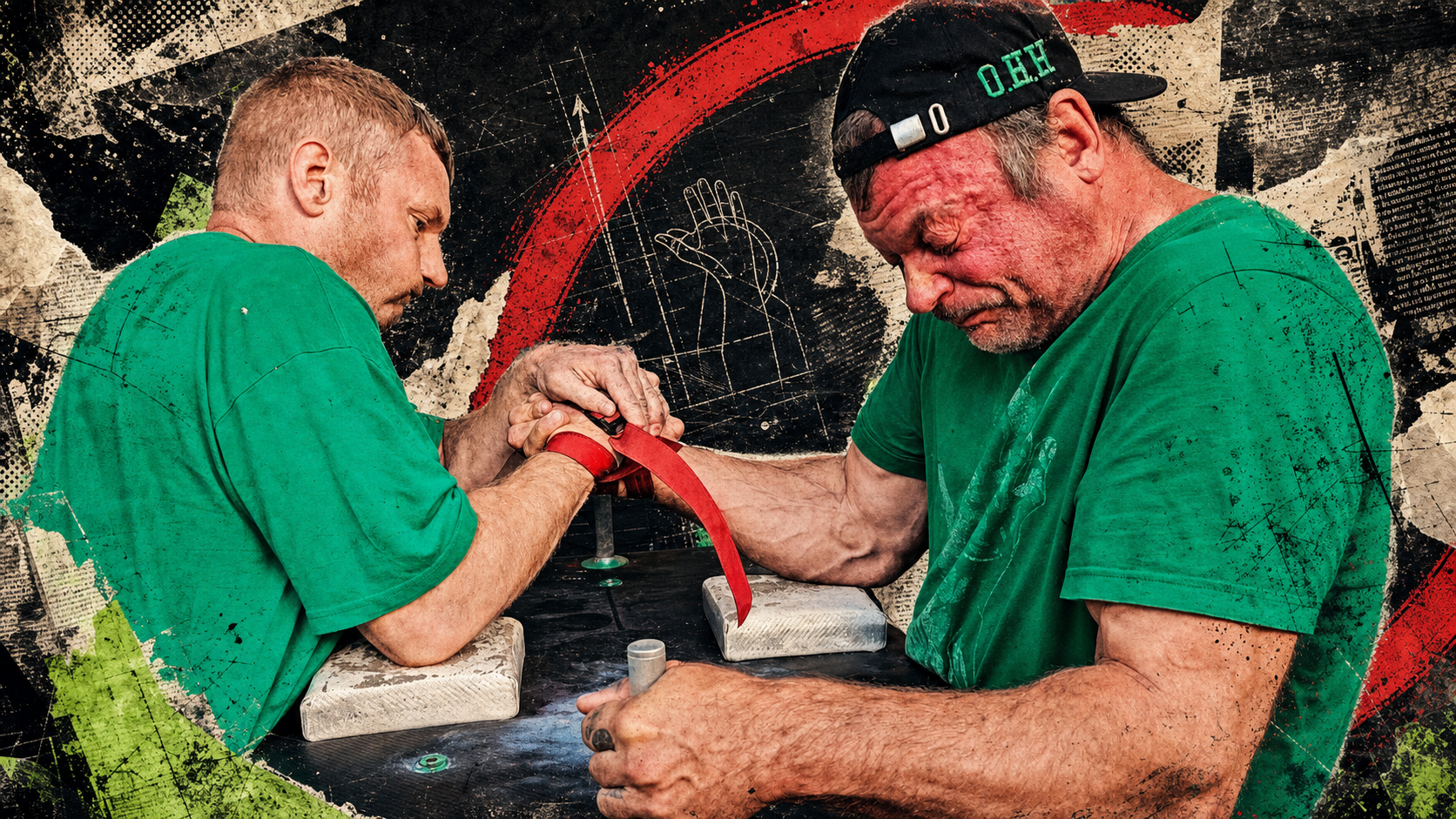
Benji Mac’s OHH 2026 footage shows Devon Larratt pulling with Ryan for nearly thirteen minutes.
The setup changes throughout the session. Their grips shift. Their starting positions move. Some exchanges continue from angles that would never survive a referee’s restart.
That makes the footage more useful as a look at Devon’s practice habits than as an unofficial match.
The Setup Keeps Changing
A regulation supermatch gives both athletes a controlled starting point. A referee sets the grip, watches the shoulders and manages the strap. Each round begins and ends under a defined rule set.
None of that applies here.
Devon and Ryan reset by feel. Their shoulder positions change between exchanges. They sometimes continue pulling after reaching positions that would normally cause a restart or foul.
Ryan also uses his free hand during part of the session. That increases the resistance against Devon, but it changes Ryan’s connection to the table. The exchange becomes a resistance drill rather than a realistic simulation of a ready-go.
Trying to score those exchanges misses what Devon appears to be testing.
Devon Starts Where Matches Usually End
Devon repeatedly stays in positions where his wrist has opened and Ryan has climbed higher in the grip.
Instead of resetting, Devon works through the disadvantage.
He moves his elbow, rebuilds his pronation and tests whether the strap can keep his hand connected. Small changes in elbow position allow him to redirect pressure without fully recovering his wrist.
Those adjustments have become central to Devon’s style. Devon keeps building strength in positions that rarely appear in ordinary gym training. He can lose clean wrist control while preserving enough hand height and back pressure to remain dangerous.
Afterpulling gives him time to study those positions.
He can hold a bad angle and wait for Ryan’s fingers to weaken. He can test how much pressure the strap carries after his wrist bends back. He can also find the exact movement that turns a collapsing position into something stable.
The value comes from the recovery, not the pin.
Ryan Keeps Forcing An Answer
Ryan makes the session useful because his hand continues to create problems.
He climbs when Devon’s wrist opens and maintains enough pressure to prevent an easy recovery. Devon has to adjust his elbow, shoulder and hand position while Ryan remains connected.
Once Devon gets the information he wants, he often changes the lane. Ryan follows him into the new angle instead of rushing toward a practice pin.
Ryan gains useful feedback as well.
He can feel when Devon transfers pressure into the strap. He can recognize which elbow movements restore Devon’s hand and which attacks create the strongest response.
That information matters far more than an afterpull score.
The Levan Comparison Has Limits
Devon’s right forearm stays under tension through several long exchanges. His wrist opens, but his pronation and back pressure remain active.
The development in his arm matches the kind of work shown on the table. He has spent years strengthening positions that most pullers try to avoid.
The sustained effort naturally led to jokes about another match with Levan Saginashvili. The comparison only goes so far.
Levan presents a much larger pressure problem. His first surge, hand control and press transition come from a referee-controlled start. Ryan’s two-handed resistance creates a different test under completely different conditions.
The OHH footage still reveals plenty.
It shows where Devon can hold after losing his wrist. It shows how Ryan attacks the hand. Most importantly, it shows which adjustments allow Devon to keep the strap involved.
This was position testing, not a verdict.
The real answers still require a referee, a ready-go and an opponent trying to finish the match.
I was born in the 1980s, so like a lot of fans, Over the Top was my first introduction to pro arm wrestling. Years later, Devon Larratt’s YouTube channel pulled me back in, and I’ve been hooked ever since. Rewatching classic matches, following the modern supermatch hype, and keeping up with the personalities, rivalries, and culture that make arm wrestling so addictive.