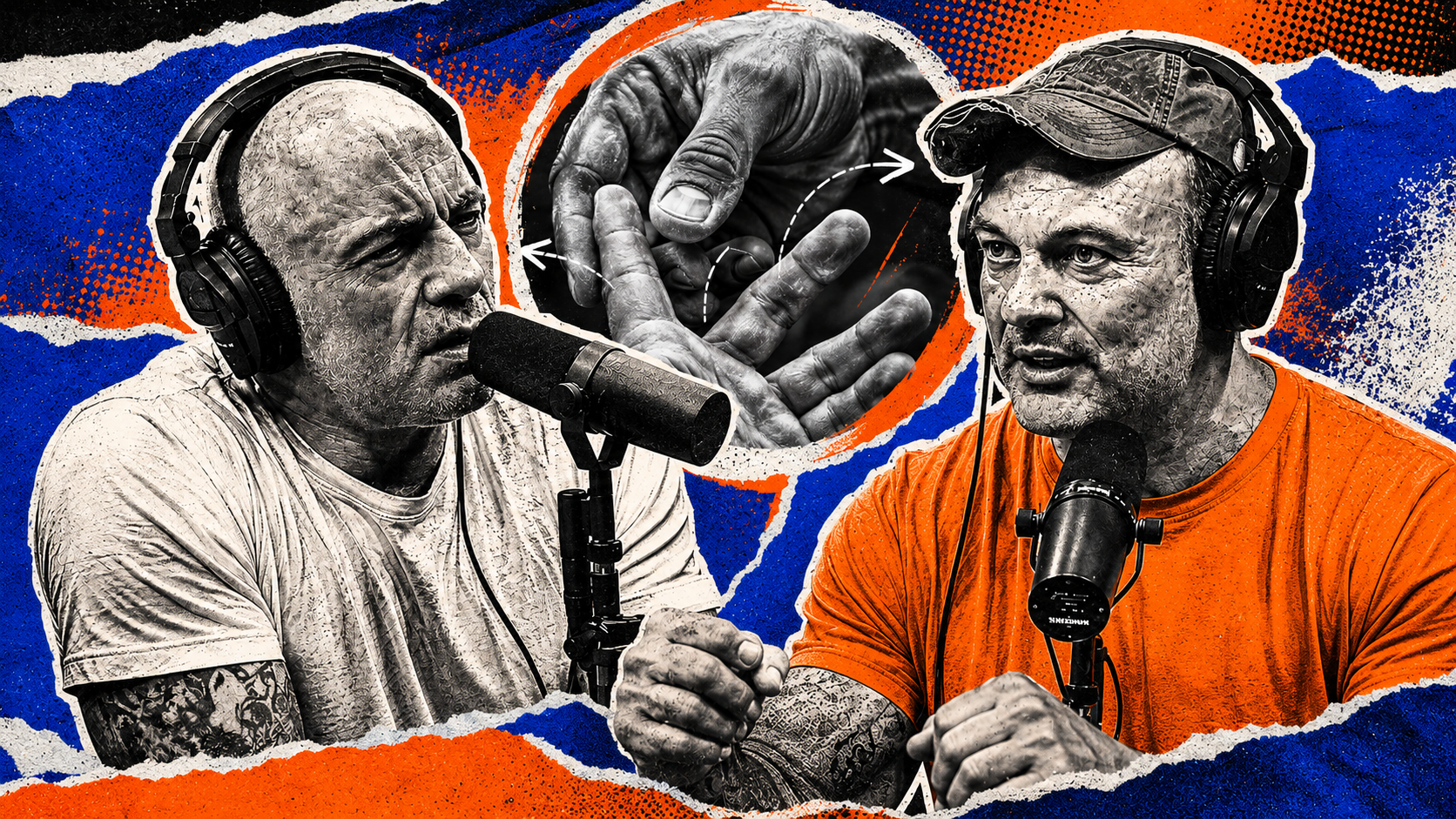
Joe Rogan wanted to talk about grippers. Devon Larratt wanted to talk about fingers.
That difference seems small until you watch elite arm wrestling closely. A crushing hand helps. Of course it helps. Rogan can squeeze a gripper harder than most gym guys ever will. Then Devon points out that his own crush number is not always impressive, yet he still beats pullers with massive hands.
Grip Opens The Door
The best part of the Rogan arm wrestling lesson was how quickly Devon moved past the obvious answer. Grip matters. It gives you defense. It adds offense. But the match changes when the other puller has to hold you with the fingertips.
That is where rising matters. A high hand forces the opponent into a worse position. Pressure moves away from the palm and out toward the fingers. The strong guy may still feel strong, but the contact starts working against him.
Once that happens, a dynamometer score loses some value. Nobody wins an arm wrestling match in a lab. The table has straps, elbows, shoulder lines, starts, fouls, and a referee who can make a comfortable setup disappear fast.
The Strap Changes The Math
Devon kept coming back to one modern truth. Elite arm wrestling often lives in straps. Once the hands slip and the strap goes on, grip becomes a different kind of control.
You can hold on and still lose the angle that matters. You can feel powerful and still be pulling through a wrist that has already been compromised.
That is why Brian Shaw’s early crossover lesson felt so blunt. His loss to Leonidas makes more sense once Devon explains how quickly general strength gets tested in referee’s grip and straps.
It also explains Devon’s training. Odd handles, table angles, small wrist movements, and awkward positions all make sense when the hand chain starts breaking in specific places.
The Wall Beats The Climber
The rock climber comparison made the same point from another angle. A climber can hang on to brutal edges. Devon wants the arm wrestler to become the brutal edge.
That is a hard problem for the opponent. He spends energy just trying to stay connected. The match slows down. A big hit turns into a long, grinding exchange. Devon likes that kind of match because he usually understands where the other puller is wasting strength.
His late-career style has leaned into those exact problems, which makes the older Devon strength question more interesting than any single gripper number.
Strong Hands Still Need Direction
A big squeeze can win casual pulls, especially when both people stay square and comfortable. Elite arm wrestling is not that clean. It turns that squeeze into a delivery problem.
The force has to travel through the wrist, elbow, shoulder, and body without leaking away. If the pressure lands on the fingertips, the other puller starts fighting his own hand. If it lands through the palm and wrist, the same force becomes dangerous.
That gave new fans a better way to watch. Watch who controls height. Watch who makes the strap work for him. Watch who forces the other man to hold on from a bad position.
Grip matters. It opens the door. Devon’s point was that the real problem starts after that.

I was born in the 1980s, so like a lot of fans, Over the Top was my first introduction to pro arm wrestling. Years later, Devon Larratt’s YouTube channel pulled me back in, and I’ve been hooked ever since. Rewatching classic matches, following the modern supermatch hype, and keeping up with the personalities, rivalries, and culture that make arm wrestling so addictive.