Published Aug 14, 2026
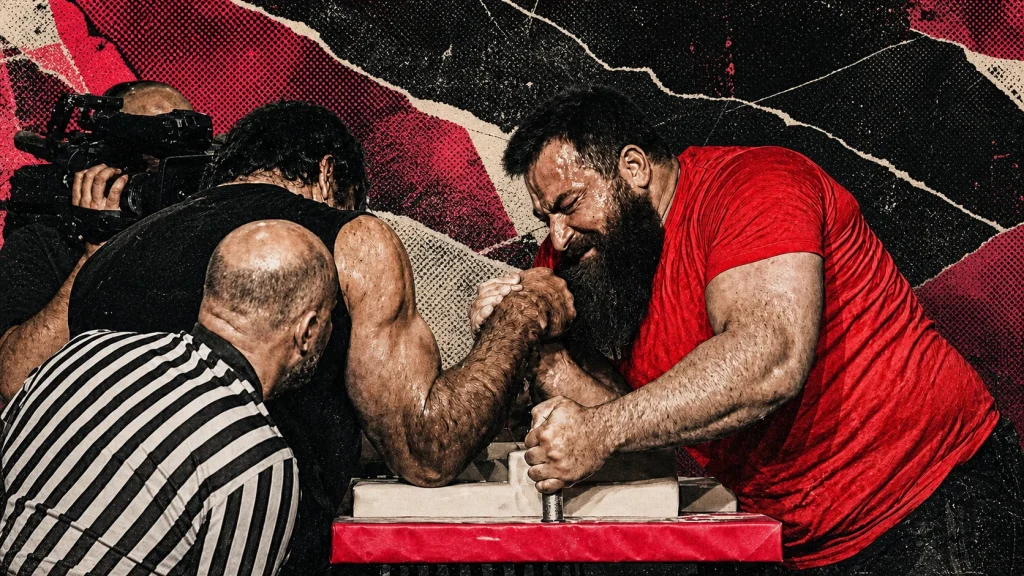
Devon Larratt had spent years making opponents pay for losing their wrist. Genadi Kvikvinia showed him how to bypass that advantage.
Genadi could commit to a flop press after the hand had been compromised. The shoulder moved behind the arm, the wrist bent back, and pressure traveled through the heel of the hand instead of depending on retained cup.
Devon discovered that taking the wrist could still leave the decisive lane open.
Hand Control Stopped Being the Finish
Devon’s outside game usually creates a predictable chain. Pronation protects his rotation. Back pressure attacks the opponent’s fingers. The strap transfers that pressure until the wrist bends and the attacking lane weakens.
Genadi separated the wrist from the finish. Once he established the press, his bent wrist did not carry the same penalty it would in a toproll. His shoulder position allowed him to drive through Devon’s arm angle while the hand remained visually compromised.
That forced Devon to solve two threats at once. He had to keep the opponent’s hand from climbing while also preventing the shoulder from crossing into the press.
The distinction echoes the lesson from Devon’s first Levan loss. A technical advantage has value only when enough force and position exist to keep the next lane closed.
Back Pressure Became the Weak Link
The most damaging exchanges appeared when Devon’s back pressure could no longer hold his arm angle.
His pronation might survive. Genadi’s wrist might remain bent. Yet Devon’s hand was being driven closer to his own shoulder as the elbow and upper arm lost separation. Once that angle opened, the press attacked below the hand control Devon had worked to secure.
This was the failure mode hidden by the usual visual cues. Devon could look successful at the wrist while losing the structure that gave the wrist meaning.
The problem also resembles the trade revealed by the giant pumpkin experiment. Table knowledge and hand position cannot fully replace specific strength in the pressured arm angle.
The Loss Sent Devon Back Inside
Genadi’s press changed Devon’s training priorities because the answer could not stay entirely outside.
Devon needed renewed cup, elbow flexion, and shoulder commitment to contest the press before it settled. Inside work gave him a way to meet pressure closer to the source instead of relying on a stretched defensive line.
Later lane selection showed the adjustment. Devon became more willing to protect the center and threaten a hook when an opponent’s press made an open outside position dangerous. His pulling against Dave Chaffee supported that broader inside return, but Genadi supplied the sharper reason.
The same question shapes the Kamil and Georgi audition for Devon. A committed press or inside surge asks whether Devon can preserve arm angle before his hand control becomes isolated.
Genadi exposed a gap between owning the wrist and owning the match. Devon’s response was to reconnect the two.

I was born in the 1980s, so like a lot of fans, Over the Top was my first introduction to pro arm wrestling. Years later, Devon Larratt’s YouTube channel pulled me back in, and I’ve been hooked ever since. Rewatching classic matches, following the modern supermatch hype, and keeping up with the personalities, rivalries, and culture that make arm wrestling so addictive.